The Legislative Branch of Florida’s government is authorized by Article III of the Florida Constitution to create and amend the laws of the state of Florida, subject to the governor’s veto. The Legislature also has the power to propose amendments to the Florida Constitution.
The only thing the Florida Legislature is required to do each year is pass a balanced state budget.
In addition, every ten years, in the second year following the census, the Legislature is required to divide the state into 30 to 40 contiguous senatorial districts and 80 to 120 contiguous house districts. Read more on the redistricting requirement here.
(The other two branches of Florida government are the Executive Branch and the Judicial Branch, which are the subjects of other primers.)
Bicameral Legislature
The Florida Legislature is divided into two chambers or houses: a 40-member Senate and a 120-member House of Representatives. For purposes of representation, the state is divided into 40 Senate districts and 120 House districts, each with roughly equal populations, every ten years following the decennial census.
All of Collier County is included in Florida Senate District 28.
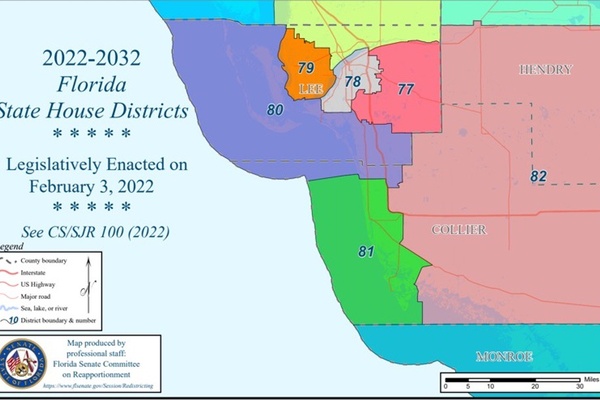
Parts of Collier County are included in Florida House Districts 80, 81, or 82. About 51 percent of Collier voters live in District 81; about 35 percent of Collier voters live in District 82, and 14 percent live in District 80.

Terms of Office, Term Limits, and Elections
Florida senators serve four-year terms with two-term limits (a maximum of eight consecutive years).
Senate elections are staggered, with 20 senators elected in presidential election years and 20 elected during the midterms. However, races following redistricting elect all 40 members to ensure that each member represents an equal number of constituents.
With two-year terms, elections for all House seats are held every two years.
State representatives serve two-year terms with four-term limits (a maximum of eight consecutive years).
Sessions of the Legislature
Every two years after the general election, the Senate and House hold organizational sessions during which they elect leaders to serve two-year terms as their presiding officers.
The Florida Legislature meets in session every year for 60 consecutive days. The regular session convenes on the first Tuesday after the first Monday in March of each odd-numbered year and on the second Tuesday after the first Monday in January of each even-numbered (election) year.
The Legislature may also be convened in special sessions by the Governor or jointly by the Senate President and House Speaker. Recent examples include sessions to address congressional redistricting (April 2022), property insurance (May and December 2022), and immigration, voter fraud, compensation of college athletes and more (February 2023).
An extension of a regular session or special session requires a three-fifths vote of each house.
Find the current year session dates in the Calendar Links section, here.
Partisan Makeup and Republican Party Control
The Republican Party has controlled both chambers of the Florida Legislature since 1999. For more, see Ballotpedia: Party control of Florida state government.
Public Participation in Florida Government

Members of the public may watch live, unedited coverage of the Florida Legislature, including committee meetings, on The FLORIDA Channel (TFC). TFC is a public affairs programming service funded by the Legislature and produced and operated by WFSU-TV. It features programming covering all three branches of state government. (For more, see TFC: How to Watch.)
Recordings of past meetings are available for viewing from TFC’s video library.
Resources
- Florida House Web Page
- Florida Senate Web Page
- Florida Senate Handbook
- How an Idea Becomes a Law – Senate Document
- Legislative Glossary – Senate Document