

Greater Naples Fire Rescue District voters will decide in an August referendum whether to increase the District’s millage (tax) rate for no more than eight years to fund the construction of new fire stations and facilities.
A majority of votes cast is needed for the referendum to pass.
This post describes the Greater Naples Fire Rescue District (District or GNFRD) and who the increase would affect, why proponents say the increase is needed, on which specific projects the proceeds would be used, and why opponents say “vote no.”
The Referendum
Referendum to increase the Maximum Millage Rate of the Greater Naples Fire Rescue District
Solely for the construction of new fire stations and facilities, existing facilities improvements, and purchase of apparatus, technology, and equipment, shall the Greater Naples Fire Rescue District be authorized to increase its currently authorized millage rate from 1.5 mills ($1.50 for every $1000.00 of assessed value), approved in 2014, up to 2.0 mills ($2.00 for every $1000.00 of assessed value), for an 8 year period, with such revenues held in a capital improvement account?
___ Yes
___ No
At the current rate of 1.5 mills, property taxes generated about $50 million this fiscal year compared with budgeted operating expenses of about $49 million, according to the FY 23/24 approved budget.
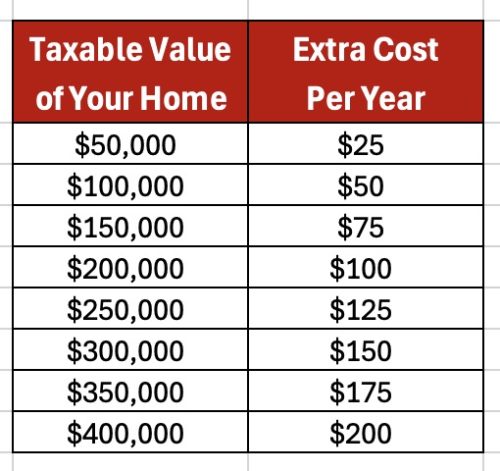
A rate of 1.5 mills equates to $1.50 for every $1,000 of a property’s taxable value. The proposed rate of 2.0 equates to $2.00 for every $1,000 of value, a 33.3% increase.
According to the GNFRD, the extra cost for a home with a taxable value of $400,000 would be $200 per year.
It would be up to the district to decide how much of the maximum amount of 2 mills to collect annually based on its budgetary needs.
About the GNFRD

The GNFRD is a Special District created to deliver fire and rescue services to its residents. Due to the specialized nature of their services, special districts must maintain their critical infrastructures and evolve with state-of-the-art tools of their trade. They are funded by property taxes paid by District residents.
See the Sparker’s Soapbox primer, Fire and Emergency Medical Services in Collier County.
The GNFRD serves 180,000 people from the edge of the city of Naples to south of Marco Island to Immokalee, including Chokoloskee, Everglades City, Golden Gate, East Naples, Isles of Capri, Port of the Islands, and surrounding communities. It is the largest Special District in Florida, covering an area of approximately 758 square miles. Including Ochopee, which is managed by but not part of the District, its service area extends 1,512 square miles.
The District’s 15 fire rescue stations are staffed with three rotating 24-hour shifts; its four administrative buildings house 260 firefighters and civilian personnel. As an “all-hazards” fire district, GNFRD has firefighting equipment, Advanced Life Support (ALS), HAZMAT (Hazardous Materials), a Technical Rescue Team (TRT), a Marine Emergency Response Team (MERT), and a Dive Team.

Today’s GNFRD was formed from the East Naples and Golden Gate Fire Districts merger in 2014.
Why the Increase is Needed
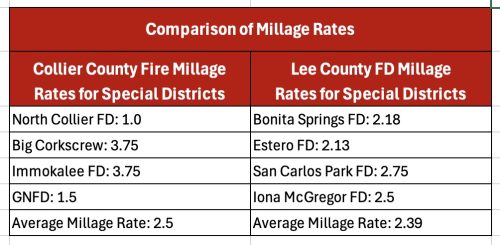
The District has had a 1.5 millage rate since the merger occurred in 2014. Even with a 0.5 mill increase, its rate would be below the 2.5 average millage rate for Collier County’s special fire districts and the average for Lee County’s special fire districts of 2.39 mills.
The District says it has taken aggressive steps to catch up with new apparatus, but continuing this replacement plan will require additional funding.
For example, new engine costs have increased 70-90% since the last purchase. Fuel and equipment costs are up as well.
In addition, according to Interim Fire Chief Chris Wolfe, the District is short at least 60 firefighters. With nearly 82% of the budget currently going toward personnel, there isn’t enough money to purchase new equipment and vehicles, maintain and repair all fire stations, or build new ones. The tax increase would free up more funds for operations, including more employees.
- Greater Naples Fire Rescue Millage Referendum Information – Story Map
- Tax hike for fire district on the ballot, Naples Daily News, 7/17/24
How the Increase Would be Used
The millage increase would be dedicated to capital projects to address aging infrastructure and eventually purchase fire apparatus, technology, and equipment to improve service. “Multiple stations are in dire need of improvements, and two need completely new stations to be re-built,” the District says in explaining the request.
The first priority would be improving living conditions inside some stations and making repairs. The second priority would be to replace outdated/broken equipment and engines that are no longer working effectively. Next would be adding a consolidated administration building and training facility. A final goal would be to offer new products and services to help residents.
According to the District’s Public Information Officer, a list of specific projects that could be funded with the increase is included in the District’s 2023-2027 Strategic Plan, beginning on page 19. The list consists of identified facility additions, upgrades, and two new facilities at estimated costs totaling about $60 million, plus specific apparatus and fleet purchases and technology needs.
Why Some Say “Vote No”
There are several reasons some oppose the proposal.
1. No Tax Increases. Period.
One is that some people oppose any tax increase for any reason.
2. “Why Didn’t They Do the Maintenance?”
Several Facebook commenters asked, “Why haven’t repairs been budgeted for in all these years???” Another wrote, “No increase on taxes; your building maintenance should be included in your budget. Shame on the management of the commissioners.” A third asked, “Does this mean no upkeep has been done on fire stations since they were built? No preventive maintenance?”
According to the Naples Daily News, Wolfe acknowledged that before he came to the district, and up until a few years ago, “there was a lack of planning to develop a normal repair and maintenance schedule” for buildings, which has led to the significant challenges [the District is] now facing.” “Before he retired, the district’s former chief had begun to turn the operations around after inheriting a “hot mess,” Wolfe said.”
3. It’s Too Big of an Increase
At last year’s taxable values, a 0.5 mill increase would result in $16.8 million in additional revenue annually or $134.4 million over eight years.
The estimated increase in the entire county’s taxable value for 2024, some portion of which is taxable by the District, is more than 10.6%.
While acknowledging a need, some say it’s simply too much of an increase over too long a period compared to the list of projects.
4. First, Do a Study
Marvin L. Easton, a District resident and former IBM international consultant involved with previous efforts to consolidate Collier County’s independent fire agencies, asks, “What are the best and most appropriate public safety organizational structures for Collier County?”
Easton suggests a study be undertaken but personally favors the consolidated approach used by the Collier County Sheriff’s and EMS (Ambulance Service) organizations. He opposes “the multiple, separately organized, and separately funded fire agencies in unincorporated Collier County, each with its own organizational structure and its own very different taxing structure.”
- Collier voters should consider fire, EMS agency consolidation, by Marvin L. Easton, The News-Press, 12/10/23
- Fire agency consolidation could reduce tax rates or improve services, by Marvin L. Easton, The News-Press, 10/29/23
Conclusion
All voters who reside in the GNFD will decide whether or not the referendum is approved. A majority of votes cast is needed for the referendum to pass.