A downloadable, printable PDF of this post is available here.
In November 2026, Florida voters will decide whether to retain Chief Justice Carlos G. Muniz of the Florida Supreme Court for another six-year term. Muniz is the only Florida Supreme Court justice on the Nov. 3, 2026, general election ballot. A simple majority vote (more than 50% of the votes cast on the question) is required for a judge to be retained.
For background on Florida’s court structure and the merit retention process, please visit The Judicial Branch of Florida’s Government on Sparker’s Soapbox.
In this post, I summarize Chief Justice Muniz’s background, judicial philosophy, and notable decisions, highlighting information that voters may find useful as they prepare to cast their ballots. I also include links where you can learn more about him and the merit retention process.
Chief Justice Carlos G. Muniz
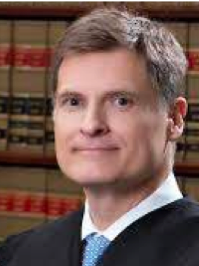
Carlos Genaro Muniz was born June 25, 1969, in Chicago, Illinois. He is the first Nicaraguan-American to serve on the Florida Supreme Court. He received a Bachelor of Arts from the University of Virginia in 1991 and a Juris Doctor from Yale Law School in 1997. After graduating from law school, he clerked for Judge Thomas Aquinas Flannery of the U.S. District Court for the District of Columbia and for Judge Jose A. Cabranes of the U.S. Court of Appeals for the Second Circuit, before briefly entering private practice at Hogan and Hartson in Washington, D.C. (FL Supreme Court; Wikipedia)
Muniz moved to Florida in January 2001 to serve as deputy general counsel in the office of Governor Jeb Bush, a position he held until June 2003. He then joined GrayRobinson in private practice before returning to state government as general counsel of the Florida Department of Financial Services from 2005 to 2006. He later served as policy director of the Republican Party of Florida and as deputy chief of staff and counsel in the Office of the Speaker of the Florida House of Representatives. (Wikipedia)
In January 2011, Muniz joined Florida Attorney General Pam Bondi’s office as deputy attorney general and chief of staff, serving until January 2014, when he returned to private practice. In March 2017, Muniz was nominated by President Donald Trump to become the General Counsel of the U.S. Department of Education, serving under Secretary Betsy DeVos. (Wikipedia)
In January 2019, Governor Ron DeSantis appointed Muniz to the Florida Supreme Court, and Florida voters retained him in a merit retention election in November 2020. His peers elected him Chief Justice in 2022; he was re-elected to a second two-year term in 2024. He is married to Kathleen Baur Muniz; they have three children. (FL Supreme Court; Wikipedia)
Judicial Philosophy
Muniz is a textualist and a member of the Federalist Society. His jurisprudence has focused on methods of interpretation: in Conage v. United States, he rejected Florida’s prior rule that courts resort to canons of construction only after finding statutory text ambiguous, directing courts instead to consider “all textual and structural clues” when interpreting statutes. As Chief Justice, he has also led the Florida Supreme Court’s civil justice reform efforts, including rule amendments requiring judges to actively manage cases from the outset and revising discovery procedures to promote a fairer and more efficient litigation process. (A Chat with the Chief Justice; Florida Bar News; Florida Bar News; Federalist Society)
Notable Cases
In Planned Parenthood of Southwest and Central Florida v. State of Florida (April 2024), Muniz joined the 6-1 majority that overturned decades of Florida precedent, ruling that the state constitution’s right to privacy no longer protects abortion rights. The ruling allowed Florida’s 15-week abortion ban to remain in effect and paved the way for its 6-week ban. During oral argument, Muniz stated he could not affirmatively say that the term “natural person” does not include the unborn. (The 19th News)
As Chief Justice, he wrote the majority opinion upholding Gov. Ron DeSantis’s congressional map, which eliminated a former Black-performing district in North Florida (Black Voters Matter Capacity Building Institute v. Byrd, July 2025). The Court held that the challengers had not shown a map satisfying both the Florida Constitution’s Fair Districts Amendment and the federal Equal Protection Clause. The decision was widely viewed as a major victory for DeSantis and significantly affected Florida’s congressional districts. (
The 2020 Florida Bar Poll
The Florida Bar poll of its members regarding the merit retention election of state Supreme Court justices and appellate court judges was discontinued after 45 years in 2023. In the 2020 Bar poll, the last one conducted before Muniz’s first retention vote, 71 percent of responding attorneys favored retaining him overall. Among respondents who reported “considerable knowledge” of him, 63 percent favored retention, the lowest approval rating of any jurist polled that year. (Florida Phoenix; Sparker’s Soapbox)
In the News
- Gov. DeSantis appoints Carlos Muniz to Florida Supreme Court. (Tampa Bay Times, 1/22/19)
- Trump included Muniz on list of potential U.S. Supreme Court nominees. (White House, 9/9/20)
- FL Bar members give high marks to Carlos Muniz for merit retention. (Florida Phoenix, 9/18/20)
- Florida voters retain justice, appellate judges. (FOX 35 Orlando, 11/4/20)
- Carlos Muniz elected Chief Justice of the Florida Supreme Court. (FL Supreme Court, 7/1/22)
- Florida Supreme Court allows abortion ban to take effect. (The 19th News, 4/1/24)
- Carlos G. Muniz re-elected as chief justice. (Florida Bar, 4/25/24)
- Justice Muniz and 22 DCA judges to stand for merit retention. (Florida Bar, 4/29/26)
- 2026 voter’s guide: Florida Supreme Court merit retention. (News4Jax, 9/24/26)
Further Research
- Chief Justice Carlos G. Muniz – official biography, FL Supreme Court
- The Votes in Your Court – nonpartisan voter guide
- Video: Interview by The Florida Bar, June 2020 (12m)
- Wikipedia
- Voting for Justice
Summary
All registered Florida voters may vote on Chief Justice Muniz’s retention in the Nov. 3, 2026, general election. If he receives a simple majority vote (more than 50% of the votes cast on the question), he will be retained to serve another six-year term.