
What insights can we gain from the recent Florida and Collier County election results? What do they tell us about our state and our community? What can we expect in terms of future government policy-making?
In this post, I’ll consider:
- Florida election results
- Collier County election results
- Implications for the future
Florida—Federal Races
With nearly 11 million votes cast and all but some overseas Vote-By-Mail ballots counted, 78.89 percent of eligible voters voted, according to the official Florida Election Watch website. This was the highest turnout percentage since the 1992 Clinton/HWBush race when the state’s turnout was 83 percent. (NBC Miami)
Like the country as a whole, Florida saw a significant shift towards Republican voting compared to previous elections.

The Vote for President
“Once a vital swing state, [Florida] is now the spiritual heartland of the MAGA movement—a place that rejected Covid restrictions, that celebrates low taxes and welcomes newcomers fleeing blue bastions like New York,” declared Joshua Chaffin in the Wall Street Journal.
Trump carried 61 of Florida’s 67 counties, flipping four traditionally Democrat strongholds: Miami-Dade, Hillsborough, Pinellas, and Duval. Osceola and Seminole counties also flipped.
“Nowhere has the Republican conquest been more startling than South Florida’s Miami-Dade County, a longtime Democratic stronghold that is the state’s most populous,” Chaffin continued. “On Tuesday, Trump won it by 11 percentage points, the first time Miami-Dade went for a Republican presidential candidate since 1988. He was powered by Hispanic voters who were in no way repelled by his vow to enact the largest deportation of undocumented immigrants in American history.”
Harris won Alachua, Broward, Gadsden, Leon, Orange, and Palm Beach counties. However, even in these traditionally Democratic-leaning counties, Harris’s margins were smaller compared to Biden’s performance in 2020, noted NBC Miami.
The Vote for the U.S. Senate
Republican Rick Scott took the U.S. Senate race by an even wider margin, defeating Democrat Debbie Mucarsel-Powell with 56 percent of the votes. Scott did even better than polls predicted, significantly improving his margin of victory compared to his 0.2 percent razor-thin victory in 2018, even though, according to Politico, Democrats had insisted that Scott’s seat was “in play.”
Florida’s senior U.S. Senator, Republican Marco Rubio, was reelected to a third six-year term in 2022. He endorsed Trump for president in 2024, days before the Iowa caucuses.
Rubio has “staked out a position as a foreign policy hawk, taking hard lines on China, Iran, Venezuela, and Cuba in particular,” and on Nov. 13 was nominated to be Trump’s Secretary of State.
If Rubio is confirmed, Gov. DeSantis will appoint a replacement until a special election can be held during the 2026 midterms.
Votes for the U.S. House
Republicans retained control of 20 of Florida’s 28 U.S. House seats; Democrats will control eight seats. (Florida Election Watch)
Overall, Republicans retained control of the House, handing the party total control of Washington with President-elect Trump back in the White House in January. (The Hill)
However, Trump’s choice of Florida Republicans Matt Gaetz as Attorney General and Mike Waltz as national security advisor will leave immediate openings on Capitol Hill for Republicans. In fact, Gaetz resigned as soon as his nomination was announced. (Washington Post)
Trump’s pick of Rep. Elise Stefanik, R-NY, to be U.N. ambassador further weakens Republican control of the House. (Newsweek)
Gov. DeSantis has called for immediate special elections to protect the Republicans’ majority in the House. (Tallahassee Democrat)
Florida–State Races
As in the federal races, Republicans dominated statewide election outcomes.
The Republican victories in Florida were described as “a wholesale repudiation of Democrat policies and Democrat policy proposals” by State Sen. Blaise Ingoglia, a former chairman of the Republican Party of Florida. (News Service of Florida)
Votes for the State Legislature
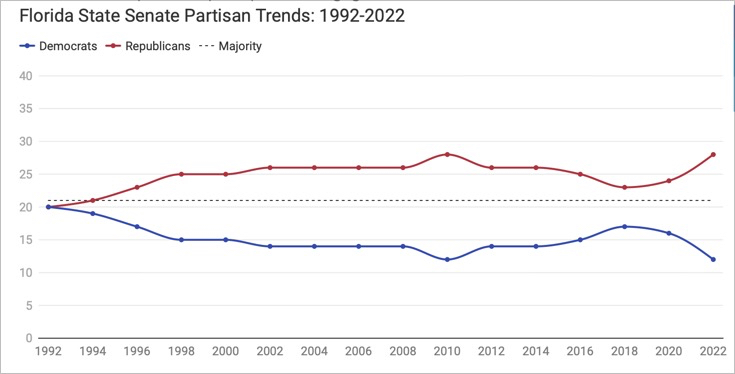
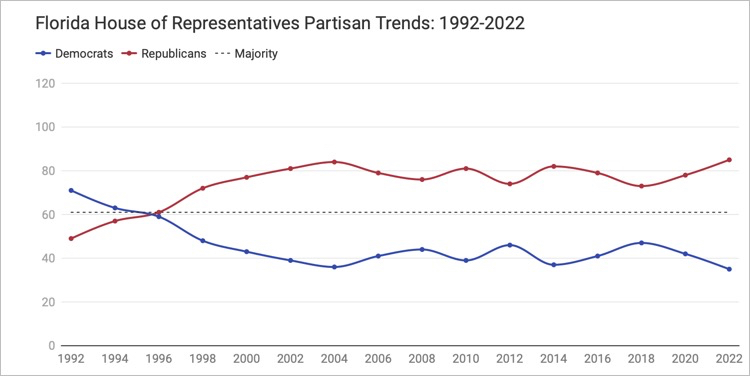
Republicans needed to lose fewer than two Senate seats and fewer than five House seats to maintain the supermajorities they have held in both legislative chambers since 1996—and they did.
In the Senate, they actually flipped two states from blue to red, giving them control of 28 of the 40 seats. In the House, they also flipped two seats, giving them 85 seats and Democrats 35 for the next two years. (Ballotpedia as of 11/11/24)
The results confirm the strengthening of Republican control in both chambers that began in 2018.
Florida’s Judicial Merit Retention Votes
Two Florida Supreme Court judges and 23 District Appeals Court judges faced merit retention votes.
All 25 received well more than the 50 percent vote needed to serve the next six-year term.
The “yes” votes in favor of retention ranged from a high of 70.68 percent (3rd District Court of Appeal Judge Kevin M. Emas) to a low of 62.33 percent (Supreme Court Justice Meredith Sasso).
Votes on the Constitutional Amendments
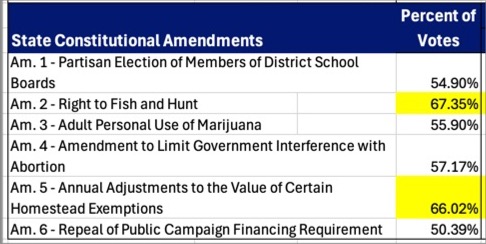
Two of the six proposed constitutional amendments on the ballot surpassed the 60 percent vote needed to pass: Amendment 2 – Right to Fish and Hunt and Amendment 5 – Annual Adjustments to the Value of Certain Homestead Exemptions.
While failing to get 60 percent, the four that failed, however, all received more than a 50 percent majority.
Amendment 3 – Adult Personal Use of Marijuana
Amendment 3 lost despite being the most expensive ballot measure battle in the nation. Trulieve Cannabis Corp., the state’s largest medical marijuana operator, pumped nearly $144.6 million into the proposed amendment, more than 94 percent of the total $152.27 million in cash raised by the Smart & Safe Florida political committee that sponsored the measure. (News Service of Florida)
The amendment had been targeted by Gov. Ron DeSantis, who, in the weeks before the election, held news conferences to speak out against the measure. State agencies also ran anti-marijuana ads. (Miami Herald)
“Its failure was one of the more shocking moments in the state’s 2024 general election,” according to USA Today – Florida. “While the polling was tight, most surveys found enough supportive Floridians for it to pass.”
“While the results of Amendment 3 did not clear the 60% threshold,” CEO Kim Rivers said in an election-night statement, “we are eager to work with the governor and legislative leaders who agree with us on decriminalizing recreational marijuana for adults, addressing public consumption, continuing our focus on child safety, and expanding access to safe marijuana through home grow.”
Amendment 4 – Amendment to Limit Government Interference with Abortion
Amendment 4 also failed to receive the necessary 60 percent vote despite millions of dollars poured into ads and other voter outreach. As a result, the state’s six-week abortion ban and other abortion laws remain in place. (F.S. 390.0111 - Termination of pregnancies)
This amendment, too, was opposed by Gov. DeSantis, who used state money, time, and his power to fight the measure. (AP News)
While supporters could try again in another election cycle, the DeSantis administration is considering further changes to the constitutional amendment process that would make it even more challenging to navigate. In addition, State Sen. Blaise Ingoglia, R-Spring Hill, has said he is already planning to adjust petition-gathering laws in the next session. (Tampa Bay Times)
Collier County vs the State
In Collier County, 82.9 percent of eligible voters cast a ballot, exceeding the state’s 78.5 percent voter turnout by nearly five points.
Voters overwhelmingly backed Republican candidates up and down the ballot, with margins often surpassing the substantial Republican victories at the state level.
Votes for President and Senate
This chart compares the statewide votes to the Collier County votes in the presidential and U.S. Senate races:
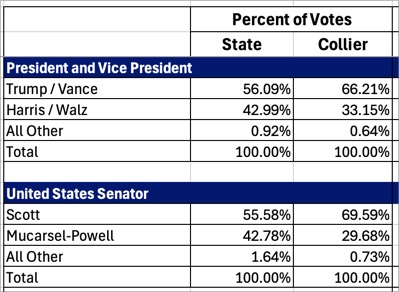
In the race for president, the Trump/Vance ticket won by a 33-point margin in Collier County compared with a 13-point margin in the state.
In the U.S. Senate race, Scott won by a 40-point margin in Collier County compared to a 13-point margin statewide.
Votes for Congress and Florida House
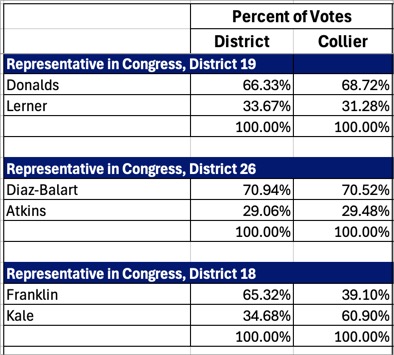
These are the votes in the three congressional and three state House districts that represent parts of Collier County:

Votes for Judicial Merit Retention
A greater percentage of Collier voters consistently supported the retention of the seven judges on the ballot than supported them statewide.

Votes on the Amendments
Collier also voted more conservatively than the state as a whole on the proposed constitutional amendments.
More than 70 percent of Collier voters supported the two amendments that passed – Amendment 2 – Right to Fish and Hunt and Amendment 5 – Annual Adjustments to Homestead Exemptions.
Conversely, a significantly smaller percentage of Collier voters supported Amendment 3 – Adult Personal Use of Marijuana and Amendment 4 – Limiting Government Interference in Abortion than supported the amendments statewide.

Collier County Local Races
Board of County Commissioners
Incumbent Republicans Rick LoCastro, District 1, and Burt Saunders, District 3, easily won their general election races.
LoCastro received 94.9% of the votes, defeating challenger Michaela Kendall, whose name, as a write-in candidate, did not appear on the ballot.
Saunders, after defeating three Republican challengers to win a closed primary in August, won 75.9 percent of the votes in the general election against No Party Affiliation challenger Richard Conover.
With these wins and that of District 5 Commissioner Bill McDaniel in a universal primary in August, Collier County’s five-member Board of County Commissioners continues as it was – at least until the next elections in 2026.
Mosquito Control and Greater Naples Fire Rescue Districts
The incumbents in these nonpartisan races all won reelection. Specifically:
- Incumbent Russell Burland received 77.8 percent of the votes, defeating challenger Lou Tinel for a seat on the Collier Mosquito Control District board;
- Incumbent Al Duffy received 38.3 percent of the votes, defeating challengers Stanley A. Bunner Jr. (with 34.6 percent) and Wayne J. Martin (with 27.2 percent) for Seat 2 on the Greater Naples Fire Rescue District board;
- Incumbent Dominick P. Biondo received 62.1 percent of the votes, defeating challenger Russell Tuff for Seat 5 on the Greater Naples Fire Rescue District board.
Marco Island City Council
Two incumbents and four challengers were vying for four seats on the nonpartisan Marco Island City Council. The four newcomers will join the board at its next meeting on Nov. 18; the two incumbents were voted out.
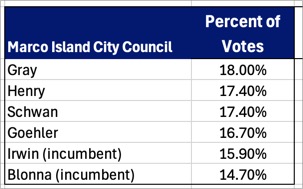
Of note, Henry is a Democrat. “I really thought being a Democrat would nail me down low,” she told the Naples Daily News in a phone interview. “I’m positive that people appreciated what I give to the community.”
The new City Council will fill the seat previously held by Greg Folley. Folley was required to resign on election day when he decided to run for State House District 81. He lost to Yvette Benarroch in the August primary.
Collier School Tax Referendum
With an overwhelming 84.7 percent of the votes, the flexibility sought in Collier School District’s Referendum will continue for another four years.
According to Lisa Morse, the District’s director of community engagement and district initiatives, in April, the referendum is essential to give the District the funds it needs to “recruit, support and retain highly effective instructional and non-instructional staff and maintain high-quality academic programs.” (Naples Daily News)
Implications for the Future
Across the board, the results were a strong endorsement of four more years of existing, if not even more conservative, policies.
State Government
In Tallahassee, Gov. DeSantis is heading into his final two years in office with a significant boost to his political clout after two ballot measures he staunchly opposed failed. In addition, the Miami Herald notes four of the six school board candidates he endorsed were winning their runoff elections.
DeSantis is not seeking a position in the Trump administration, he said on a road trip to Indiana. He can best make a difference “quarterbacking the Sunshine State.” (Florida Politics)
Beginning on Nov. 19, the State Senate and House will have new leaders for the next two years. At that time, incoming House Speaker Daniel Perez and incoming Senate President Ben Albritton will formally begin their new roles.
“As a House, we should do what Florida’s working families do every day: budget their money responsibly,” Perez wrote in a memo to House members, announcing a “leaner” committee structure and renaming the Appropriations Committee as the Budget Committee.
Perez also announced changes in the House Education & Employment Committee, where he said subcommittees will move away from a “historic K-12/higher education divide.” “We need to see our education system as a singular enterprise with the purpose of preparing our kids for their futures, whether those futures lead them to college or a profession,” the memo said.
Albritton has said he expects to focus during the 2025 and 2026 legislative sessions on issues involving agriculture and the child-protective system. (News Service of Florida)
County Government
With no change in leadership at the county level, the policies and programs currently underway will likely continue.
The five incumbent Collier County Commissioners and four of the five incumbent constitutional officers (Sheriff, Supervisor of Elections, Tax Collector, and Clerk of Courts and Comptroller) will continue in their positions, and incumbent Property Appraiser Abe Skinner, who is retiring, will be succeeded by his deputy, Vickie Downs.
School Board
With the election of the two incumbent school board members in the August primaries, the make-up of the board for the next two years is also set and the policies and programs underway in the District are also likely to continue.
With the failure of Amendment 1, school board elections will remain nonpartisan for the foreseeable future.
And passage of the local school tax referendum means that the recently agreed teacher salary increases for the 2024-2025 school year will not require programming cuts to pay for them.
In Conclusion
The people have spoken. The Republican Party continues its decades-long control of our state and most Florida county governments.
“Whenever the people are well-informed, they can be trusted with their own government,” wrote Thomas Jefferson in 1789. “Whenever things get so far wrong as to attract their notice, they may be relied on to set them to rights.”
With the 2024 elections behind us, we must continue to monitor and inform ourselves about our government. I intend to do so, and I hope you will, too.