
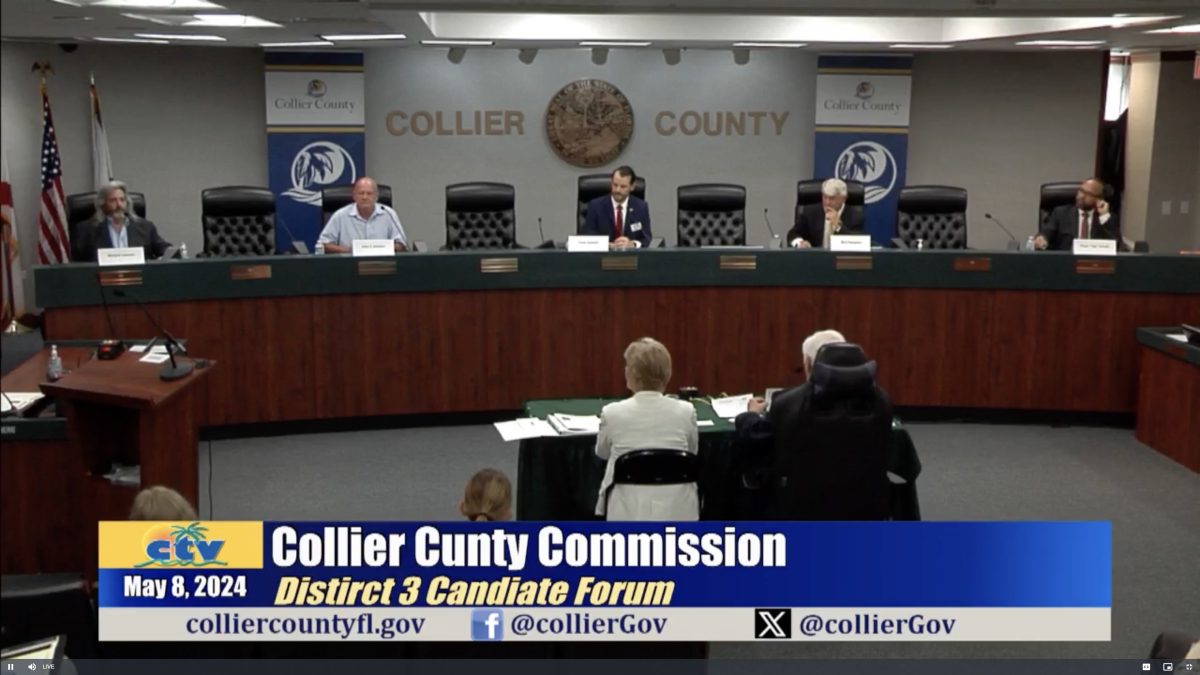
Last Wednesday, five candidates running to represent Collier County Commission District 3 had the opportunity to introduce themselves and answer several important questions at a forum co-hosted by Greater Naples Leadership and Collier Citizens Council on behalf of a coalition of local community organizations. Over 90 minutes, their positions on issues, strengths and weaknesses, similarities and differences became readily apparent.
District 3 residents who are registered Republicans on July 22 will choose among the four Republican candidates in a closed primary election on August 20. The winner of the primary will face the No Party Affiliation challenger in the general election in November.
In this post, I summarize what I learned about the candidates from their opening and closing remarks and responses to the questions. My intent was to share as much of the substance and “flavor” of the candidates’ speaking style as succinctly as possible. I did not attempt to verify the veracity of statements made by the candidates or clarify or elaborate on what was said.
Watch the forum recording on the Collier County government website.
Richard Conover
Richard Conover, age 60, is the No Party Affiliation candidate.
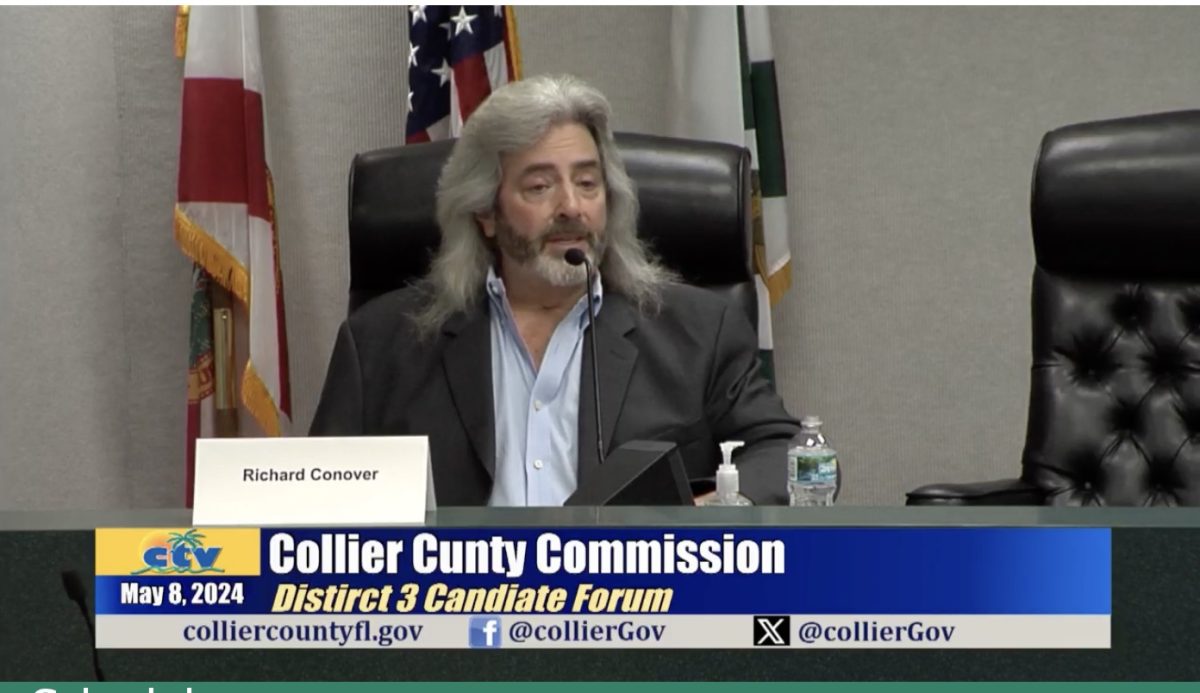
He is a State Farm Insurance Agent whose office is on the corner of Golden Gate Parkway and Collier Boulevard. He said he also owns several businesses in Collier County.
After being frustrated at his inability to stop a rezoning that would allow four houses on his street to be bulldozed for Mason Classical Academy, he decided to run for county commissioner. “There’s a loophole that allows these things to happen,” he said.
Conover said the most important issues facing Collier County are residential rezoning, prioritizing roadway projects, and closing loopholes in the Growth Management Plan.
Collier County has not elected a non-Republican to a partisan office in 40 years, he said. “I’m asking you to open your mind to the idea of voting for a non-Republican. Think about whether you’re happy with the way things are now or not.”
John C. Johnson
John C. Johnson, age 69, now retired, was a lifelong businessman and local builder.

He moved to Naples 18 years ago from Chicago, where he held political office as a Democrat, because “you had to be.” “When I came here, I became a Republican because that’s what you are in Florida,” he said.
Johnson is running because he wants to change the county’s permit system, which he called horrific. He’s pessimistic about being able to do anything to address District 3’s traffic problems. “We can’t expand Immokalee Road. Can’t expand Vanderbilt. I don’t know how to stop it,” he said.
Johnson also wants to address the affordable housing shortage, stop growth by creating more neighborhood parks, and support veterans.
Frank Roberts
Roberts was born and raised in Columbus, OH. He played small college football and got an MBA in Kansas. About 12 years ago, he moved to Collier County to attend Ave Maria Law School. After serving as an Air Force Judge Advocate for six years, he returned to Collier County in 2021 to practice law.
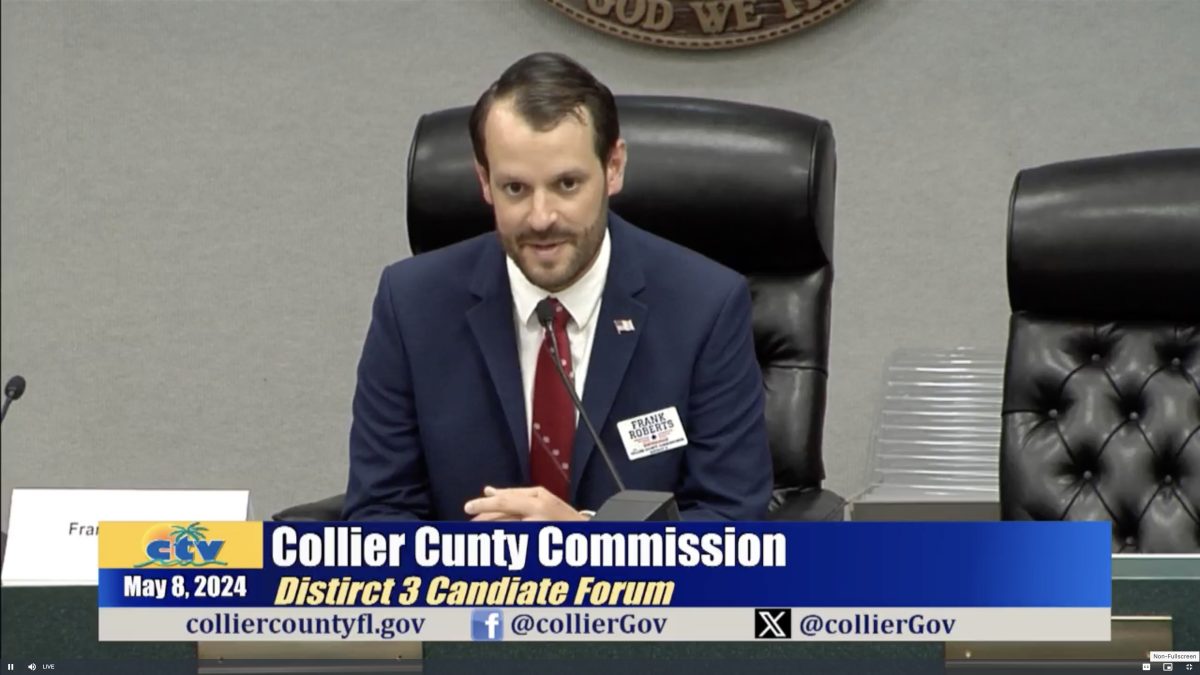
Now, he says, he’s “ready to serve.” “We’re at least ten years behind on the infrastructure and keeping up with the growth we face so far,” he said.
Roberts’ top priorities are putting families first and the issues that affect them, specifically traffic (“getting their kids to school and themselves to work on time”), a “COVID-19 After-Action Report”, and proposed constitutional amendment 4.
“We have to decide if we’re going to be a state that supports life and the idea that human life begins at conception or we’re going to be a state that stands with North Korea and China in terms of severity and extremism,” he said. “I’m clear on the side of life.”
Burt Saunders
Saunders, the incumbent, is seeking a third and final term on the Board of County Commissioners.

Saunders represented Collier County as county attorney for several years, state representative for four years, and state senator for ten years before returning to the private practice of law in 2008.
“In 2016, the county commission was in disarray. I felt I could bring some maturity and some experience and get things on the right track,” he said. We’ve done that, he said, but he wants to serve one more term. “Experience matters.”
“This truly is one of the most important, if not THE most important, elections in the history of Collier County,” he said. The other candidates are committed to reducing the millage rate to the rollback millage rate in each of the next three years. That “will be a disaster for this community.”
“We all said we need more infrastructure, we need more of this, we need more of that. Well, you can’t continually cut the millage rate to the rollback millage rate year after year after year and accomplish that. It’s impossible,” he said. “You can’t put $53 million back into Conservation Collier as you’re cutting taxes. Those things just don’t add up.”
Floyd “Tag” Yarnell
Yarnell moved to Collier County with his parents in 1979. After graduating from USF in 1983, he worked in business for a few years, then attended law school at Nova Southeastern, graduating in 1999. Since then, he’s practiced law and is currently the managing partner of Yarnell & Peterson, where his practice includes construction litigation and construction management.
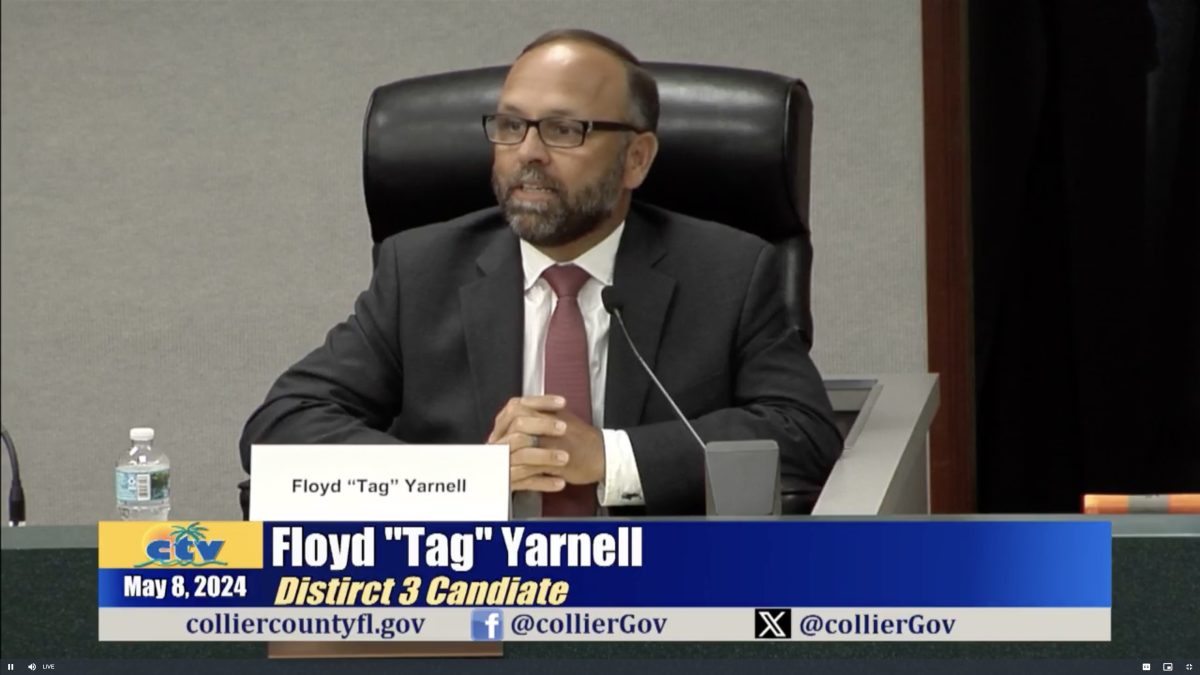
“I’m a Christian, a husband, a father, a conservative, and a businessman,” whose wife works at a Christian nonprofit that helps battered, abused, and trafficked women who become pregnant get the life skills they need, he said. His three guiding principles are faith, family, and community.
According to Yarnell, the most important issues facing Collier County are traffic and infrastructure, attainable housing, and “health and safety, inclusive of Amendment 4. “I plan on being here to utilize my conservative values to help the people of Collier County.”
After several general questions, the moderator asked each candidate to respond to these specific questions:
Use of Tourist Tax Dollars
Q: Do you support using tourist tax dollars to promote Naples’ tourism?
Saunders, Yarnell, and Conover all said they support using the county’s tourist tax dollars to promote tourism.
Johnson first said he couldn’t comment without knowing more about it. But “I would be all in favor of raising the tourist tax, that’s for sure, because that way, we would take the burden off the people that live here without having to raise property taxes.”
Roberts first said that, as a conservative, he doesn’t like taxes. But tourists paying “their fair share to upkeep the resources we have isn’t a problem.” However, he would not want promoting tourism to “take away from the other priorities I have.”
Reintroducing the One-Cent Sales Surtax
Q: What do you think about reintroducing the extra penny sales tax?
Johnson is “150 percent for” reintroducing the one-cent sales surtax that expired last year. “It would keep us from having to raise property taxes,” he said. “Let’s get that 1% back. And I’d like to make it for a lifetime.”
The other four candidates opposed the idea.
“As a fiscal and social conservative, I am against any additional taxation.” (Yarnell)
“As a local businessman, I am not for burdening anybody with new taxes.” (Conover)
“I signed a pledge not to raise taxes. It’s a non-starter for me.” (Roberts)
Saunders spoke of the benefits the county realized due to the $500+ million raised from the surtax passed in 2018, which he had fully supported. But he does not support reintroducing it now.
Water Quality
Q: On the topic of water quality, what do you hope to achieve in the next four years?
While all acknowledged that water quality is a problem, the candidates interpreted the question in varying ways.
Conover spoke of red tide and phosphates that leak into our groundwater. He wants to “make sure we use natural methods to keep our fresh waters clean” and cited the Naples Bay project’s use of oyster beds as an example.
Roberts, too, spoke of forever chemicals, plastics, and fertilizer runoff seeping into the aquifer. He said the Board of County Commissioners should be studying it to understand what’s getting into the water and where it’s coming from, as well as studying red tide. “Once it’s understood where the source of the problems are, that’s when the local government can apply the pressure to fix the problems,” he said.
Johnson’s concern was saltwater getting into the aquifers. If that happens, he said, “we have a problem. We should take advantage of the saltwater we have. Take the salt out of it and make it good water. They do it on cruise ships,” he said. “I don’t see why we can’t do the same thing.”
“The issue is, how do we preserve and protect our shorelines, lakes, and rivers?” Saunders said. “I was once asked, what is the number one environmental problem facing Collier County? And I said the fact that the County Commission and the candidates don’t support Conservation Collier. That’s one mechanism we have that can really help solve that problem.”
Yarnell emphasized the importance of public-private partnerships to address issues such as the location of reservoirs in the state, lower use of fertilizers, and septic-to-sewer conversions.
Use of Conservation Collier Funds
Q: $53 million was taken out of the Conservation Collier fund in 2023 for non-conservation use. The current commission chair said it was a one-time thing, but now a majority of the commission members voted for an ordinance change that allows the removal of funds for any undefined emergency. Do you support this?
“If they needed the money, but they’re going to give it back, I don’t have a problem with it. If it was just sitting there, the way it was explained to me, it was just sitting in account. It wasn’t doing anything. I think they should get it back, and I don’t think they should take it again.” (Johnson)
“I don’t have a problem with what the county commissioners did.” Maintenance of lands purchased with the Conservation Collier funds should be continued, but otherwise, there is no benefit in the funds “sitting idle.” And “they’re pledging to put it back for use in the future.” (Roberts)
“The County Commission cannot put that $53 million back in. The millage rate has been lowered, which I don’t necessarily disagree with. I think it was lowered too much. But there’s no capacity to put that $53 million back in. And to say that we’re going to do it is just not accurate.” (Saunders)
There should be an audit to make sure the funds are being used as voters intended. “If there’s money out there that can benefit Collier as a whole, it should be able to be used. If we are overfunding, that should be addressed.” (Yarnell)
Conservation Collier “is the people’s will.” But the commissioners allowed the money to sit there, properties were not being acquired, and then it got raided by another program. “We need to stop being politicians and start doing what we told the people we’re going to do.” (Conover)
Mental Health
Q: What ideas do you have to address mental health issues in the county?
Something the government can do and has the resources to do is tell people that it’s okay to get help. (Roberts)
Through the one-cent sales tax, we funded a mental health intake facility to help address the fact that the sheriff is the largest provider of mental health services in the county. We have fully funded the sheriff’s needs ever since I’ve been on the Board. (Saunders)
Continue to use whatever program is currently in place. In addition, funds should be allocated within the county budget to address the mental health needs of first responders. Shift funds within the sheriff’s budget to fund mental health needs, but “I wouldn’t support additional taxation to provide that.” (Yarnell)
“I applaud the Board for putting together a program to address mental illness. But it’s not easy to get the help. I have a daughter who has mental illness, so I have a personal vested interest in making sure it gets the attention it needs in Collier County.” (Conover)
Concentrate on helping families by giving them support to help their children and older people with Alzheimer’s. (Johnson)
Form of Government
Q: Would you support a voter referendum to let voters choose an alternative form of county government where the Board of County Commissioners are voted at large, rather than now where commissioners are elected in separate districts?
Yes. “Several months ago, I proposed to the county commission that we set up a committee to evaluate the pros and cons of [doing so]. And the commission had no interest in discussing it. If I’m re-elected, I’m going to bring that issue back because I think we make better decisions when we’re elected countywide.” (Saunders)
No. “I believe that it is important to have each district being represented by someone who lives in that district and that represents the interest of that district.” (Yarnell)
No. Doing so would make it “virtually impossible for a non-Party candidate to get on the ticket. The fees would be so high, and the bar would be set so high that it would virtually guarantee a good old boy network.” Also, “Why do we need to change our form of government to expect accountability and honesty from our county commissioners? Why can’t we count on our county commissioners to do what’s right for the county now? If we can’t, we need to replace them.” (Conover)
No. “There was a storage unit that Burt [Saunders] voted against and a housing project that he voted against. The other commissioners voted for it. To me, this is my district. You stay the hell out of it.” (Johnson)
No. “It goes back to the fundamental principle [that] you need to elect who represents your district and where you live. I’m of District 3, for District 3, I want District 3 represented and their voice heard on the Board of County Commissioners.” (Roberts)
Infrastructure Needs
Q: What are the most pressing infrastructure needs in the county?
All five candidates mentioned traffic and roads. Other issues mentioned were:
- Stop residential rezoning; stop increasing density. (Conover)
- Bring water and sewer into Golden Gate City (where I own “quite a bit of real estate”) (Johnson)
- Affordable housing (Saunders; Yarnell)
- Parks and Recreation (Saunders)
The Money
While it’s still early in the race, it’s interesting to look at the money each candidate has raised and spent to date.
This chart summarizes the total amounts reported through March 31, 2024.
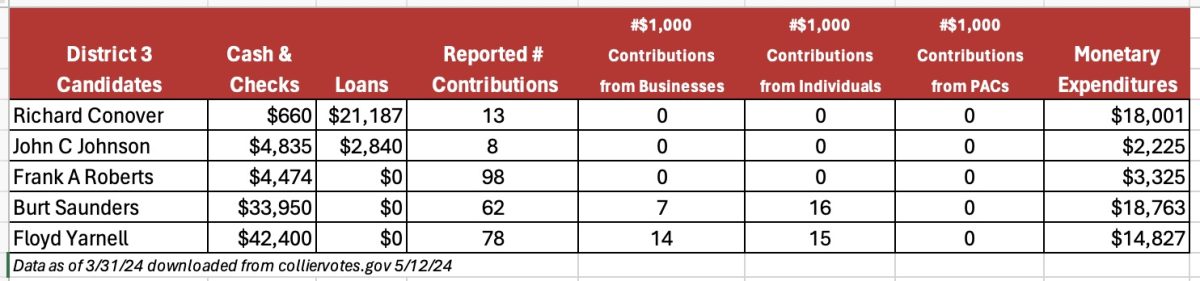
Details are from the candidates’ campaign treasurer’s reports, which can be found on the Supervisor of Elections website by clicking on a candidate’s name.
Only two candidates received contributions of the maximum allowable $1,000. Here are details of them:
For More Information
- Richard Conover website
- John C. Johnson website
- Frank A. Roberts website
- Burt Saunders website
- Floyd Yarnell website
- Florida’s Primary Election Process: A Soapbox Primer
- The Collier County Board of County Commissioners: a Soapbox Primer
- Collier County Government website
- Collier County Board of County Commissioners webpage